


Learning on the Go — Simple Activities for Family Travel
Your family is waiting at the airport. Your child has finished a snack, looked around the departure lounge and asked how much longer you have to wait.
You check the time. There are 35 minutes until boarding.
“How did you work that out?” they ask.
That small question can become a learning activity. Travel gives families real information to read, quantities to estimate and unfamiliar places to explore together. Choose an activity when your child is interested and keep it short enough to fit the moment.
Estimate Before Checking
Journeys offer plenty of opportunities to make a prediction, then compare it with the answer.
For younger children, you might estimate how many steps it takes to reach a nearby gate while walking together. Older children could estimate the time remaining before departure or the length of a queue.
Ask two questions.
“What is your estimate?”
“What helped you choose it?”
After checking, discuss how close the estimate was and what information would make the next one more accurate.
Turn a Timetable Into a Small Maths Challenge
Suppose a train leaves at 14:25 and arrives at 16:10.
Ask your child how they would calculate the journey time.
One approach is to count 35 minutes from 14:25 to 15:00, then 1 hour and 10 minutes from 15:00 to 16:10. The total is 1 hour and 45 minutes.
Let your child explain another method if they have one. You can adapt the task by asking a younger child to identify the departure time or an older child to compare two possible connections.
Give Your Child a Reading Role
Choose one useful piece of information for your child to find.
They could check a gate number, read the opening hours of a museum or look for the name of the next station. With younger children, read together and ask them to spot a familiar word or symbol.
For older children, try a question that involves selecting relevant information.
“We want to visit this place tomorrow morning. Which part of the notice tells us whether it will be open?”
Ask them to show you where they found the answer.
Explore a Map Together
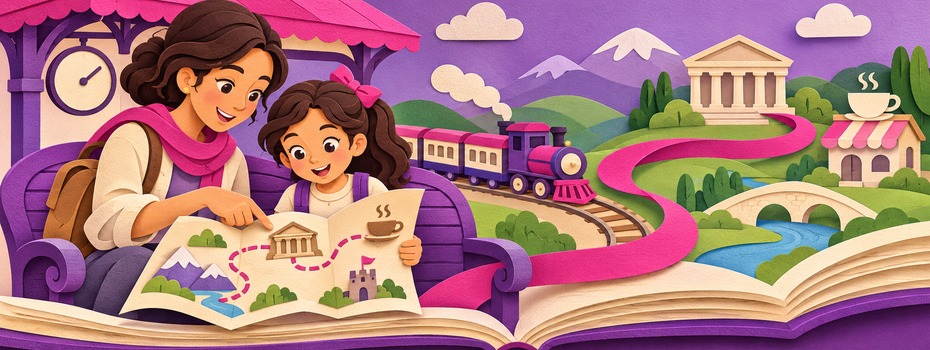
Before visiting a new place, look at a map and choose two or three landmarks.
Ask your child to describe where one place is in relation to another. Younger children can practise words such as “beside,” “between” and “opposite.” Older children might compare routes or use a scale to estimate distance.
After the visit, invite them to sketch the route from memory. Compare the sketch with the map and discuss what they remembered.
Try One Real Spending Decision
A café menu or ticket list can provide a practical arithmetic question.
For example, three sandwiches cost AED 18 each and two drinks cost AED 7 each. Ask your child to estimate the total before calculating it.
The sandwiches cost AED 54, the drinks cost AED 14, and the total is AED 68.
Adjust the task to suit your child. They might add two prices, calculate change or compare the cost of individual tickets with a family ticket.
Keep a Tiny Travel Journal
Give your child a manageable format they can complete in a few minutes.
| Journal prompt | What they could record |
|---|---|
| Something I noticed | A drawing, photograph description or short sentence |
| Something I wondered | One question about a place, object or experience |
| Something I learned | An answer they discovered during the day |
A child who enjoys drawing could fill most of the page with pictures. Another might prefer a short paragraph or a voice note.
On the next day, return to one of their questions and decide together how to investigate it.
Match the Activity to the Moment
A family journey includes waiting, excitement and tiredness. Choose activities your child can comfortably join.
| Travel moment | A short activity |
|---|---|
| Waiting to board | Work out the minutes remaining |
| Walking through a town | Find a landmark on the map |
| Looking at a menu | Estimate and calculate a total |
| Visiting a museum | Choose one object and ask a question about it |
| Settling down in the evening | Add one observation to a travel journal |
One thoughtful conversation can be enough for that part of the day.
Frequently Asked Questions
Do we need worksheets or special resources?
You can use information already around you, such as maps, menus, signs and timetables. A small notebook is useful if your child wants to draw or record observations.
How can siblings of different ages join in?
Use the same setting with different tasks. One child might identify a price, another add two items, and an older sibling calculate change.
Should we continue formal study during a trip?
Consider any school commitments alongside your family’s plans. If your child has assigned work, agree on a manageable time to complete it. Discuss longer absences or missed lessons with their teacher.
If your family is planning travel during a period of ongoing tuition, discuss lesson timings and current learning goals with the tutor before you leave.