
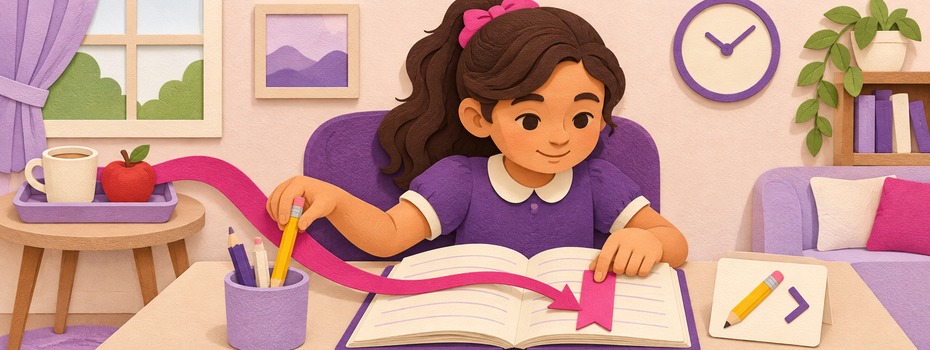





“Where Was I?” — Helping Your Child Restart After a Study Break
Your child pauses their homework for a snack. When they return, they look at the page, rearrange their pencils and ask what they were supposed to do next.
The work is familiar. Finding the starting point again takes time.
Before the next break, try leaving a short note that answers one question.
“What is the first thing I will do when I come back?”
Choose a Clear Stopping Point
Look at the task together before your child steps away.
They might finish one calculation, mark the sentence they are reviewing or save the paragraph they have drafted. If they need to stop halfway through, ask them to indicate the last completed step.
For paper work, a small pencil mark or bookmark may be enough. For digital work, save the file and leave the relevant section easy to find.
Write a Restart Note
Keep the note short and specific.
| Task | A useful restart note |
|---|---|
| Maths worksheet | “Start question 4. Find a common denominator first.” |
| Reading assignment | “Continue from the bookmark. Look for why the character leaves.” |
| Writing task | “Add an example to the second paragraph.” |
| Science revision | “Try the second question with the notes closed.” |
| School project | “Check the labels on the diagram.” |
Let your child choose the wording. Read it back together and check whether it gives them an action they can recognise.
Agree on What Happens After the Break
Before the break begins, decide when the next work period will start and which task your child will return to.
Use a familiar way to keep track, such as a clock or an agreed reminder. Keep the plan appropriate to your child’s age, workload and needs.
When it is time to return, direct them to the note.
“Show me the first action you planned.”
Give them a moment to read it and begin before adding more instructions.
Worked Example — Returning to a Writing Assignment
Suppose your child is writing about a favourite place.
They have drafted an opening paragraph and listed three details for the next section. They stop for a break.
Before leaving, they write:
“Choose one detail from my list and describe what I could see there.”
When they return, they select the view from a window and write two sentences about it.
After that small action, they can decide what comes next using the assignment plan.
If they remain stuck, ask whether the note was clear enough or whether they need help with the writing itself.
Keep Materials Ready for the Return
Check what your child will need for the next step.
A textbook might need to stay open at an example. A ruler could sit beside the diagram. A project file should be saved where your child can find it.
Ask them to organise these materials before the break. This gives them a role in preparing their own return to work.
Help With One Decision at a Time
If your child comes back and says, “I don’t know what to do,” begin with the stopping point.
Ask what they completed before the break. Then look at the next requirement together.
Choose one action they can attempt.
If they need a concept explained, pause to work through it. Afterwards, let them carry out the next step independently.
Review the Routine Briefly
After trying the approach, ask your child what helped and what remained difficult.
Perhaps the note named a question but did not explain how to begin. Perhaps they returned to the wrong page. Perhaps they could restart easily but needed help later in the task.
Adjust one part of the routine for the next session.
Use the Same Approach Between Lessons
A restart note can also connect one tuition session to the next.
At the end of a lesson, your child could record what they practised and one question they want to attempt again. They can bring that note to the next session and discuss their attempt with the tutor.
Keep it linked to actual work, such as a question number, paragraph or diagram.
Frequently Asked Questions
What if my child needs an unexpected break?
Let them mark where they stopped when practical. You can help reconstruct the next step when they return.
Should every break have a written note?
Use the amount of support the task needs. For a short, familiar activity, pointing to the next question may be enough.
What if returning to work is consistently difficult?
Record a few examples of what happens before and after the break. Discuss them with the teacher or tutor to identify whether the difficulty involves the task, instructions or organisation.
Bring a recent homework example to a TheTuitionE demo lesson and discuss where your child can work independently and where they need a clearer next step.