
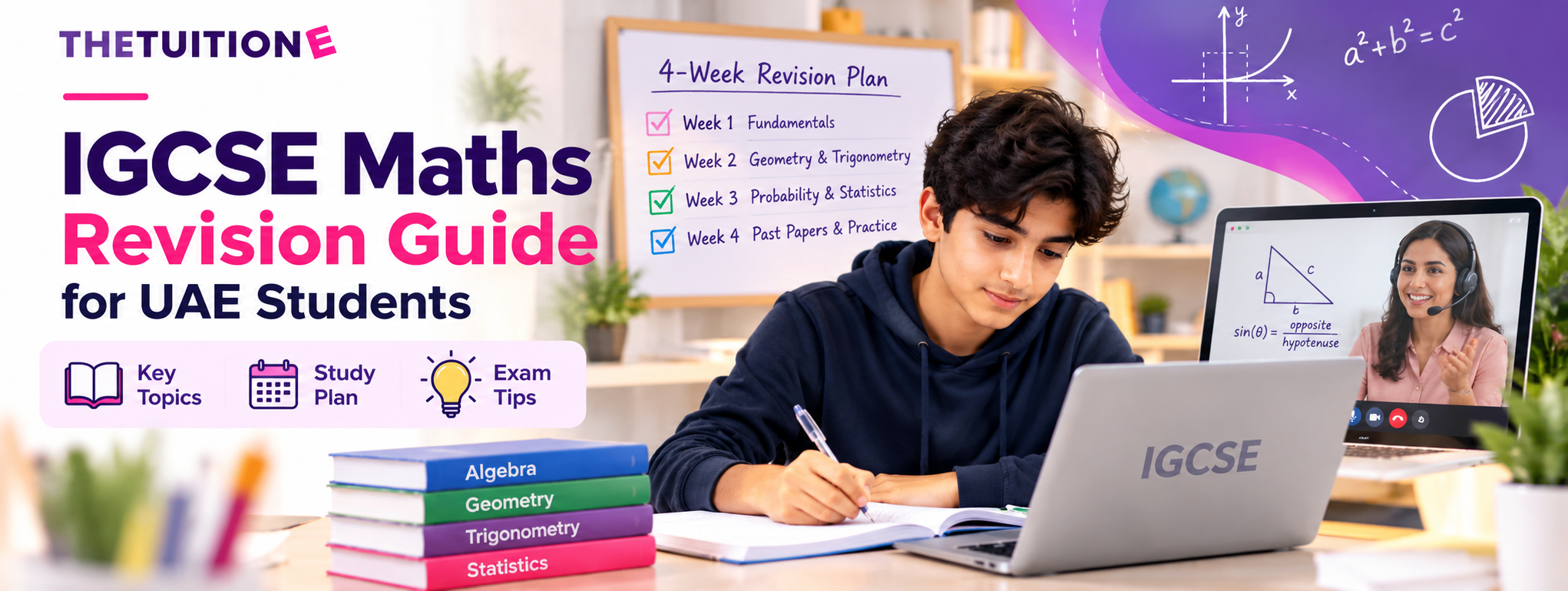





Preparing for IGCSE Mathematics can feel overwhelming, especially when students have to balance school assignments, revision, mock examinations and other subjects. For students in Dubai, Abu Dhabi, Sharjah and across the UAE, the key to effective preparation is not simply studying for longer hours. It is knowing what to revise, how to practise and how to identify mistakes before the final examination.
Whether your child is preparing for Cambridge IGCSE Mathematics or Pearson Edexcel International GCSE Mathematics, a structured revision routine can make learning more manageable.
This guide explains the important Maths topics, how Cambridge IGCSE examinations work, a practical four-week revision plan and ways parents can support their children.
Understanding the IGCSE Maths Curriculum
IGCSE Mathematics helps students develop numerical skills, mathematical reasoning and problem-solving abilities.
Two widely used international qualifications are:
Cambridge IGCSE Mathematics (0580): Offers Core and Extended routes, with assessments designed to test mathematical knowledge and application.
Pearson Edexcel International GCSE Mathematics: Offers its own specification and assessment structure, which students should check before choosing revision materials.
Although these qualifications cover many similar mathematical concepts, their papers, grading and examination requirements are not identical.
Students should always identify their examination board and syllabus code before beginning serious revision.
What Are the Most Important IGCSE Maths Topics?
A successful revision plan should cover the full syllabus rather than focusing only on a few favourite chapters.
For Cambridge IGCSE Mathematics (0580), the major content areas include the following.
1. Number
Number skills provide the foundation for many other areas of Mathematics.
Important concepts include fractions, decimals, percentages, ratios, proportion, indices, standard form and numerical calculations.
Revision tip: Practise calculations without a calculator regularly. Check whether you understand why each mathematical operation works instead of memorising steps.
2. Algebra and Graphs
Algebra is essential for solving equations, interpreting relationships and understanding mathematical patterns.
Students should practise simplifying expressions, factorisation, solving equations, inequalities, sequences and graphs.
For example, solve:
3x + 7 = 22
Subtract 7 from both sides:
3x = 15
Divide by 3:
x = 5
The calculation is straightforward, but more complex examination questions may require students to translate a word problem into an equation before solving it.
3. Geometry and Mensuration
Geometry involves understanding shapes, angles and spatial relationships. Mensuration focuses on measurements such as area, surface area and volume.
Students should revise angle properties, circles, polygons, perimeter, area, volume and relevant geometric reasoning.
A common mistake is using the correct formula with incorrect units. Always check whether a question requires centimetres, square centimetres or cubic centimetres.
4. Trigonometry
Trigonometry connects angles and side lengths.
Students should become comfortable with sine, cosine, tangent and the application of trigonometric relationships to geometric problems.
Revision tip: Draw a clear diagram, identify the known values and select the appropriate relationship before calculating.
5. Probability and Statistics
Probability and statistics assess students' ability to interpret information and reason about uncertainty.
Important areas include averages, data representation, probability calculations and interpreting statistical information.
Practise questions involving charts, tables and unfamiliar real-world situations rather than relying only on textbook exercises.
6. Coordinate Geometry, Transformations and Vectors
These topics require students to interpret diagrams, understand positions and apply mathematical rules accurately.
Regular diagram-based practice can help students avoid errors involving signs, coordinates and directions.
Cambridge IGCSE Maths: Core vs Extended
For the Cambridge 0580 syllabus used in 2025–2027 examinations, students take two papers according to their entry tier.
| Route | Papers | Calculator Rules |
|---|---|---|
| Core | Paper 1 and Paper 3 | Paper 1: No calculator; Paper 3: Calculator |
| Extended | Paper 2 and Paper 4 | Paper 2: No calculator; Paper 4: Calculator |
Both papers in each route contribute equally to the final qualification.
The Extended route covers additional mathematical content and allows access to higher grades. The appropriate route should be discussed with the student's school and teacher.
Important: This information applies specifically to Cambridge IGCSE Mathematics 0580 for 2025–2027. Pearson Edexcel and other specifications may have different assessment arrangements.
A Practical 4-Week IGCSE Maths Revision Plan
A revision timetable is most effective when it combines concept review, independent practice and regular testing.
The following four-week plan is an example for students who have already covered most of their syllabus. It should be adjusted to their examination board, current ability and remaining preparation time.
Week 1: Strengthen Mathematical Foundations
Focus: Number, algebra and fundamental calculations.
Review essential formulas and methods.
Practise fractions, percentages, ratios and equations.
Complete topic-based examination questions.
Record mistakes in a dedicated revision notebook.
Weekly goal: Identify the basic concepts that need additional attention.
Week 2: Practise Geometry and Applied Mathematics
Focus: Geometry, mensuration, trigonometry and coordinate geometry.
Review diagrams and geometric properties.
Practise applying formulas to different question types.
Solve word problems independently.
Revisit difficult questions after receiving feedback.
Weekly goal: Improve the ability to choose the correct mathematical method.
Week 3: Work on Probability, Statistics and Mixed Questions
Focus: Probability, statistics, transformations and mixed-topic exercises.
Complete questions from different chapters in one sitting.
Practise interpreting graphs and tables.
Revise topics identified as weak during the first two weeks.
Begin working with examination-style time limits.
Weekly goal: Become more confident switching between mathematical topics.
Week 4: Past Papers and Final Revision
Focus: Examination technique and targeted improvement.
Complete suitable past papers under timed conditions.
Review answers using the official marking guidance where available.
Identify repeated calculation and reasoning errors.
Practise questions from weak topics again.
Maintain a realistic routine with adequate rest.
Weekly goal: Improve accuracy, time management and examination confidence.
How to Use IGCSE Maths Past Papers Effectively
Past papers are valuable because they help students become familiar with examination-style questions.
However, simply completing many papers does not guarantee effective revision.
Try this approach:
Step 1: Choose the correct paper. Match the examination board, syllabus, tier and relevant syllabus year.
Step 2: Attempt questions independently. Avoid looking at worked solutions before making a genuine attempt.
Step 3: Review the marking scheme. Understand which mathematical steps are expected and where marks may be awarded.
Step 4: Categorise mistakes. Separate errors into concept gaps, calculation mistakes, misreading questions and time-management problems.
Step 5: Retry incorrect questions. Return to them after a few days to check whether the underlying problem has been resolved.
Cambridge provides official past papers, specimen papers and examiner reports through its subject resources.
Common IGCSE Maths Revision Mistakes
Memorising formulas without understanding them
A formula may be easy to remember but difficult to apply in an unfamiliar question.
Students should understand the meaning of the quantities involved and practise selecting formulas independently.
Ignoring weak chapters
Students often spend more time on topics they already enjoy.
Instead, a revision timetable should allocate additional attention to areas where mistakes occur repeatedly.
Practising only with a calculator
For Cambridge IGCSE Mathematics 0580, the 2025–2027 assessment includes a non-calculator paper at both Core and Extended levels.
Mental arithmetic, fractions, algebraic manipulation and accurate written calculations therefore remain important.
Skipping working steps
A correct final answer is important, but clear mathematical reasoning also matters.
Students should practise presenting their methods in an organised way.
Leaving timed practice until the last week
Timed practice should be introduced gradually so that students learn to manage examination pressure without sacrificing accuracy.
How Parents in the UAE Can Support IGCSE Maths Preparation
Parents do not need to be Mathematics experts to help their children prepare effectively.
Start by discussing which topics feel difficult and checking whether revision goals are realistic.
Encourage a consistent study routine rather than expecting several hours of intensive revision every day.
It can also help to review mock examination feedback, celebrate improvements in understanding and make sure students have time for breaks and sleep.
If your child repeatedly struggles with the same mathematical concepts, additional academic guidance may be useful.
When Should You Consider an Online IGCSE Maths Tutor?
An online IGCSE Maths tutor may be helpful when a student:
Understands classroom explanations but struggles to solve questions independently.
Repeatedly loses marks in algebra, geometry or other important topics.
Needs help organising revision before mock or final examinations.
Finds it difficult to understand mistakes from marking schemes.
Benefits from individual explanations and guided practice.
One-to-one tutoring allows lessons to focus on the student's actual learning needs instead of following the same pace as a larger group.
At TheTuitionE, students can explore personalised online tutoring support for Mathematics and other academic subjects.
A productive tutoring approach begins by identifying learning gaps, selecting appropriate practice questions and reviewing progress over time.
Build a More Focused IGCSE Maths Revision Routine with TheTuitionE
Every student learns differently. Some need help rebuilding fundamental concepts, while others understand the syllabus but need more examination practice.
TheTuitionE supports students through personalised online learning, with tutors who can adapt explanations and practice activities to individual academic needs.
Families can also explore AssessPro, TheTuitionE's assessment portal, as an additional learning resource.
Looking for support with IGCSE Maths preparation?
Visit TheTuitionE to explore online tutoring options, or visit AssessPro to explore assessment resources.
Frequently Asked Questions About IGCSE Maths Revision
1. How should I start revising for IGCSE Maths?
Begin by identifying your examination board and syllabus. Review your recent test results, list difficult topics and create a timetable that includes concept revision and regular question practice.
2. Is IGCSE Maths difficult?
Difficulty varies depending on the student's mathematical foundation, examination tier and confidence with problem-solving. Consistent practice and timely feedback can make challenging topics more manageable.
3. How many hours should I revise IGCSE Maths each day?
There is no single ideal number. A focused 45–60-minute session may be a useful starting point for some students, while others need a different schedule depending on their goals and workload.
4. Can I prepare for IGCSE Maths online?
Yes. Students can use online lessons, syllabus resources, practice questions, past papers and individual tutoring support to prepare effectively.
5. What is the difference between Cambridge IGCSE Maths Core and Extended?
Core covers foundational syllabus content, while Extended includes additional material and provides access to higher grades. Students should confirm the correct route with their school.
6. Are past papers enough for IGCSE Maths preparation?
Past papers are important, but they should be combined with concept learning, topic-specific exercises and careful review of mistakes.
7. Can an online Maths tutor help with examination preparation?
An experienced tutor familiar with the relevant syllabus can explain difficult concepts, guide examination practice and help students develop a more structured revision routine.
Final Thoughts
Effective IGCSE Maths preparation is about more than completing exercises or memorising formulas. Students need a clear understanding of mathematical concepts, regular independent practice and a reliable way to learn from mistakes.
By combining a realistic revision timetable, suitable past papers and targeted support, students can approach their examinations with greater confidence.
Start with the topics you find most challenging, practise consistently and measure your progress one step at a time.
.png)
.png)
.png)

.png)