


Beyond the Timetable — How to Plan a Useful Revision Session
Your child has made a colourful revision timetable.
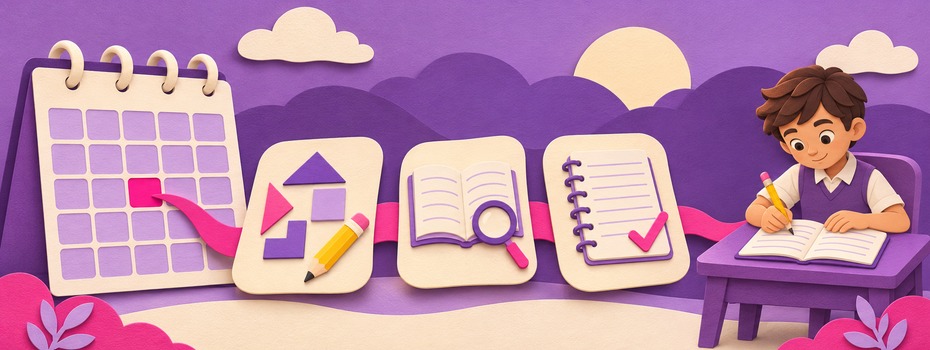
Monday says Maths. Tuesday says Science. Wednesday says English.
When Monday arrives, they open the Maths textbook, read a few pages and spend the rest of the session deciding which questions to attempt.
The timetable gave them a time and a subject. They still needed a task.
Before the next session, help your child answer one question.
“What will you practise, and how will you check it?”
Start With a Recent Piece of Work
Choose a marked assignment, class exercise or practice paper. Ask your child to identify one question they found difficult.
Look for a task small enough to revisit in a single session. “Fractions” could become “adding fractions with different denominators.” “English writing” could become “using evidence to support one point.”
If neither of you can identify the difficulty, take the example to the teacher or tutor and ask where to begin.
Write a Task Your Child Can Recognise
Use a short sentence that describes an action.
| Broad timetable entry | More specific revision task |
|---|---|
| Revise Maths | Solve four questions on adding fractions with different denominators |
| Study Biology | Explain how water moves into and out of plant cells |
| Revise English | Write one paragraph that links evidence to a point |
| Study Physics | Calculate moments using force and distance from a pivot |
| Revise Computer Science | Complete a truth table and explain two of its rows |
Choose the task from work your child has already encountered, using their current curriculum and teacher’s guidance.
Give the Session Three Parts
A manageable session can include a first attempt, focused help and another attempt.
Begin with a question. Ask your child to try one example or explain what they remember. This gives you something specific to check.
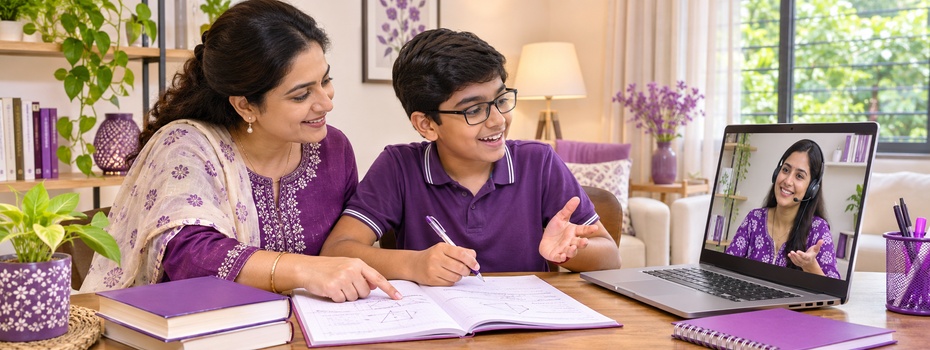
Review the point where they became stuck. They might consult a worked example, their notes or a teacher’s correction. Ask what the explanation helps them change.
Try a fresh question. Close the example and let your child work independently. Compare the two attempts afterwards.
Adjust the length to your child’s age, workload and the difficulty of the task.
Worked Example — A Short Fractions Session
Suppose your child added ⅓ and ¼ and wrote ²⁄₇.
Ask them to explain how they reached the answer. Their working suggests they added the numerators and denominators separately.
The revision task could be:
“Use a common denominator to add fractions with different denominators.”
Review one example together. For ⅓ + ¼, rewrite the fractions as ⁴⁄₁₂ and ³⁄₁₂, giving ⁷⁄₁₂.
Then ask your child to try ½ + ⅓ independently. The answer is ⁵⁄₆.
Discuss why the denominator stays at 6 when the numerators are added. Finish with another question so your child can repeat the method.
Decide What Counts as Progress
Agree on what you will look for before the session begins.
For the fractions example, your child should be able to choose a common denominator, rewrite both fractions and add them correctly.
They might complete the first two steps independently but make a calculation error. Record that specifically so the next session addresses the remaining difficulty.
A brief note is enough.
“I can find a common denominator. I need to check my multiplication when rewriting the fractions.”
Keep a Short Record for the Next Session
At the end, ask your child to complete three lines.
| Prompt | Example |
|---|---|
| I practised… | Adding fractions with different denominators |
| I can now… | Choose a common denominator and rewrite the fractions |
| Next time I will… | Try mixed questions and check each multiplication |
Use the note when choosing the next task. Return to the skill in a later session to see what your child can still do independently.
Leave Space for Adjustments
A revision plan may need to change after a lesson, an assessment or an unexpectedly difficult task.
If a session reveals a missing prerequisite, make that the next focus. If your child completes the task confidently, ask the teacher or tutor which variation would be appropriate next.
Keep the plan connected to their actual work.
Frequently Asked Questions
How long should a revision session be?
Choose a length your child can manage alongside schoolwork and other commitments. Begin with one clearly defined task and adjust the time after seeing how the session goes.
Should every session begin with a test?
A single question, quick sketch or verbal explanation can provide a starting point. Choose a format that lets your child show what they remember.
What if my child spends the whole session reviewing notes?
Pause and select one question they can attempt using those notes. Afterwards, try a similar question with the notes closed to identify what needs more practice.
Bring a recent assignment to a TheTuitionE demo lesson and discuss one specific skill your child could focus on in their next revision session.