




“I Know It, but I Can’t Explain It” — Helping Your Child Put Ideas Into Words
Your child chooses the correct answer. You ask how they worked it out.
“I just know.”
You invite them to explain a little more, but they become frustrated. They may have an idea they cannot yet organise into sentences. They may also need to revisit part of the topic.
Start with the work in front of you and ask them to show one small part of their thinking.
Begin With Something They Can Point To
An open question such as “Explain everything” can be difficult to begin.
Choose a specific detail instead.
In Maths, ask which number they used first. In reading, ask which sentence helped them choose an answer. In Science, ask what changed during an experiment.
Let your child point, draw or demonstrate before speaking. Then invite them to describe what they have shown.
Give the Explanation a Simple Shape
Try three prompts.
“What is your answer?”
“What helped you decide?”
“How does that support your answer?”
Use them flexibly. Your child may need only one prompt, or they may benefit from discussing each part separately.
The aim is to connect their answer with a reason or a piece of evidence.
Worked Example — Explaining a Maths Decision
A question asks whether 24 can be divided equally among 3 groups.
Your child answers yes.
Ask, “How could you show me?”
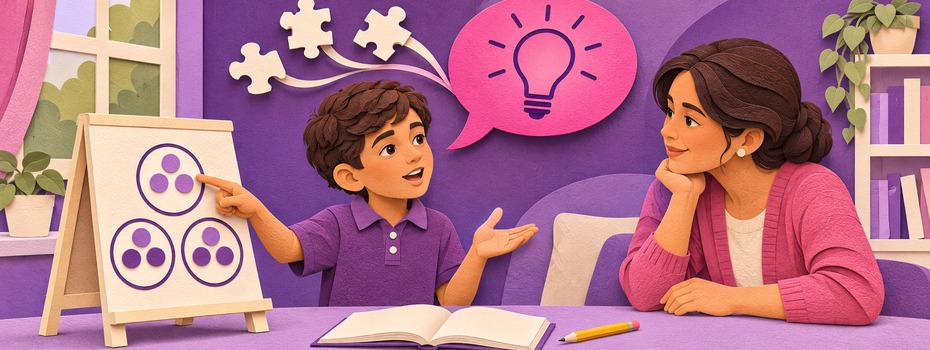
They might draw three circles and distribute 24 dots between them. Each circle contains eight dots.
Help them turn the drawing into a sentence.
“Yes. Twenty-four can be divided into three equal groups because each group has eight.”
Then ask them to check the explanation with multiplication.
“Three groups of eight make twenty-four.”
For a fresh attempt, ask whether 25 can be divided equally into three groups of whole objects. Let your child choose how to demonstrate and explain their answer.
Use a Sentence Starter When Needed
A short opening can help your child begin.
| What they need to explain | A sentence starter |
|---|---|
| A choice | “I chose this because…” |
| A method | “First I…, then I…” |
| Evidence from a text | “This detail suggests… because…” |
| A change | “When… changed, … happened.” |
| A comparison | “Both…, but…” |
| Uncertainty | “I understand…, but I’m unsure about…” |
Once they begin, listen to the whole thought before suggesting a correction.
If the explanation is incomplete, ask about the missing connection. For example, “How does that detail show the character was worried?”
Give Them Time to Finish
After asking a question, pause.
Your child might need to look back at the page, choose a word or change the order of their explanation. Avoid supplying the next sentence immediately.
If they ask for help, offer a small prompt connected to what they have already said.
“You told me which measurement you used. What did you do with it?”
Let Them Explain to a Real Listener
Choose a short task with a clear purpose.
Your child could explain the rules of a game, show a family member how to make something or describe one idea from a lesson.
Ask the listener to identify one part they understood and one part they would like clarified.
For example:
“I understand how to begin the game. When does a player get another turn?”
That gives your child a specific part to revise.
Separate the Idea From the Wording
Listen for meaning before polishing the language.
If your child has a sound explanation with awkward phrasing, acknowledge the reasoning first. You can then discuss one sentence that would make it clearer.
If the reasoning is uncertain, return to the example or evidence together. Ask them to try again after reviewing that part.
Bring a Specific Example to the Tutor
Share a question your child answered correctly but could not explain.
Ask the tutor to listen to their reasoning during a fresh attempt. This may help identify whether they need support with the concept, subject vocabulary or the structure of an explanation.
Agree on one manageable goal, such as explaining why they chose a method before calculating.
Frequently Asked Questions
What if my child says the question is too easy to explain?
Ask them to imagine teaching it to someone encountering it for the first time. Invite a drawing or demonstration, then discuss which detail that learner would need.
Should I correct every language mistake?
Choose corrections that help the listener understand the idea. Follow any specific language goal set by the teacher, and leave room for your child to finish their thought.
What if they explain better in a home language?
Let them explore the idea in a language they can use comfortably. Afterwards, identify the school vocabulary needed and practise expressing the same idea in that context.
Bring a recent school question to a TheTuitionE demo lesson and discuss how your child approaches both the answer and the explanation.