Services Available in UAE, KSA, Qatar, India and Bahrain.
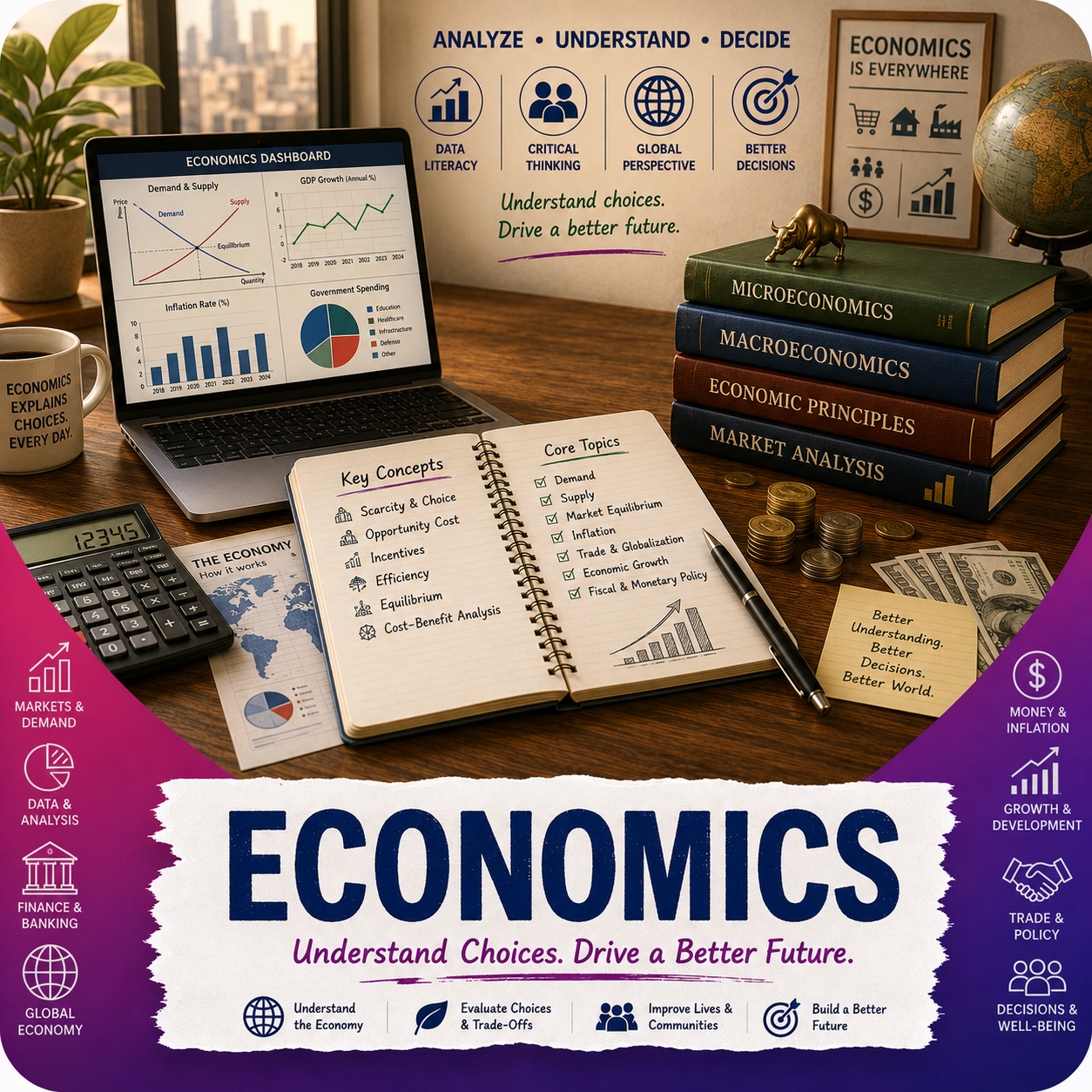
Learn Economics online through interactive live classes led by experienced tutors. Our personalized lessons are suitable for school students, college learners, beginners, and professionals who want to understand markets, demand and supply, inflation, economic growth, trade, finance, and government policies.
Join our online Economics classes and develop the analytical skills needed to understand how individuals, businesses, governments, and global markets make decisions. Build a strong foundation for academic success, higher education, business studies, finance, public policy, and economics-related careers.
Studying economics cultivates a wide range of transferable skills. These include:
Economics as a subject introduces students to two broad branches—microeconomics and macroeconomics. Microeconomics focuses on individual agents like households, firms, and markets, exploring demand and supply, price mechanisms, elasticity, production, and market structures. Macroeconomics deals with national and international economic systems, including topics such as inflation, unemployment, economic growth, fiscal and monetary policies, and international trade.
Economics integrates well with other disciplines such as political science, history, geography, business studies, and mathematics. For example, understanding economic systems is vital in geography, and concepts like GDP or inflation have historical and political implications. Analytical skills developed in economics enhance mathematical learning, while debates and policy discussions foster critical thinking.
In early grades (Grades 6–8), students are introduced to foundational concepts like needs vs. wants, resources, saving, spending, and simple economic systems. These basics are taught through storytelling, real-life examples, and interactive activities.
In middle grades (Grades 9–10), the curriculum becomes more structured. Students learn about markets, consumer behavior, basic economic theories, banking systems, and government roles in the economy. Topics such as scarcity, opportunity cost, and market equilibrium are introduced in simplified terms.
In senior secondary levels (Grades 11–12), economics is typically divided into microeconomics and macroeconomics. Students explore national income accounting, aggregate demand and supply, price determination, economic indicators, globalization, development economics, and the role of international financial institutions like the IMF and World Bank. Advanced mathematical and graphical tools are used to analyze real-world scenarios.
Economics education is vital in a globalized world where students must navigate complex financial and policy landscapes. Understanding inflation, taxation, loans, employment, and trade policies equips students to be financially literate and responsible citizens. As future voters, entrepreneurs, or policymakers, students who study economics are better prepared to contribute meaningfully to society.
A background in economics opens up diverse career opportunities. Students can pursue higher studies and careers in:
Economics is foundational for competitive exams like UPSC, GRE, and civil services worldwide. It also serves as a co
Teaching economics requires a blend of theory and application. Interactive tools such as simulations, case studies, data analysis projects, real-world news evaluation, and debates are used to help students understand abstract concepts. Technology plays a crucial role, with online resources, economic games, and statistical tools enhancing engagement.
Teachers use formative and summative assessments, including MCQs, case-based questions, essays, projects, and presentations, to evaluate understanding. Critical-thinking questions and real-life economic issues are used to encourage application rather than rote learning.
Some challenges include making abstract concepts relatable, addressing gaps in numeracy skills, and ensuring contextual relevance for diverse learners. Overcoming these requires differentiated instruction, real-life case studies, use of multimedia tools, and cross-disciplinary collaboration.
These make economics more accessible, interactive, and reflective of the digital economy students live in.
Economics empowers students to understand the mechanisms that drive personal finance, national development, and global interactions. It shapes informed individuals who can analyse economic issues critically, make reasoned decisions, and contribute responsibly to the world. As a subject, it fosters both intellectual curiosity and practical acumen, making it a vital discipline across all educational stages and curricula.