Services Available in UAE, KSA, Qatar, India and Bahrain.
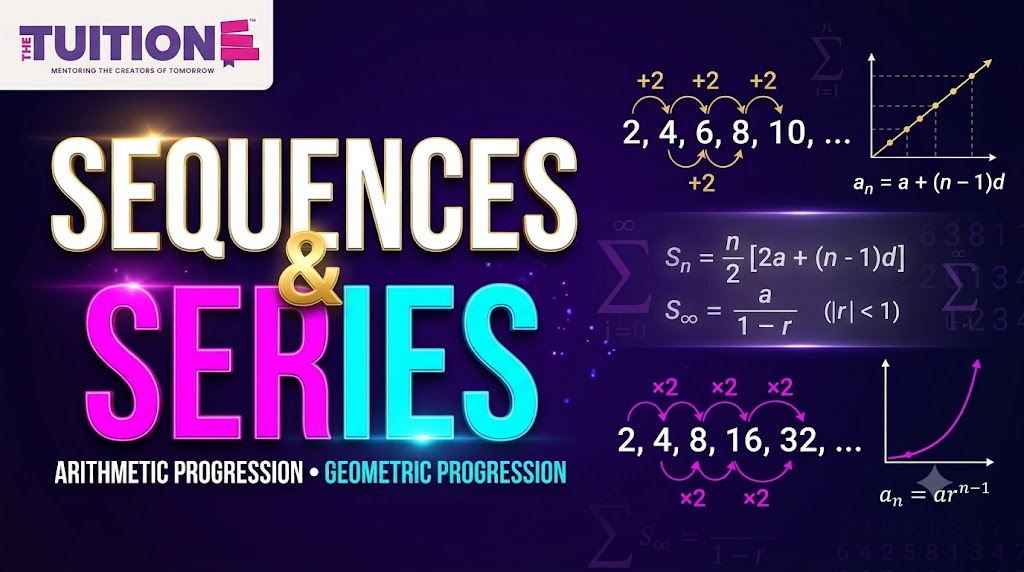
Sequences and Series | Arithmetic and Geometric Progressions| Grade: XI

CBSE Grade XI Mathematics
9 views
This lesson introduces students to the mathematical concepts of sequences and series, with particular emphasis on Arithmetic Progressions (AP) and Geometric Progressions (GP). Students learn to identify numerical patterns, calculate common differences and common ratios, and apply formulas to determine the nth term and the sum of a given number of terms. The lesson also covers Arithmetic Mean (AM), Geometric Mean (GM), insertion of means and the condition for the sum to infinity of a GP. The relationship between AM and GM, including the inequality AM ≥ GM for positive numbers, is introduced alongside formulas for the sums of natural numbers, squares and cubes. Teachers can connect these concepts with practical situations such as regular savings, population growth and compound interest. By the end of the lesson, students should be able to recognise different progression patterns, select appropriate formulas and solve related mathematical problems with accuracy.

Frequently Asked Questions

A sequence is an ordered list of numbers arranged according to a specific pattern or rule. A series is the sum of the terms of a sequence. For example, 2, 4, 6, 8 is a sequence, while 2 + 4 + 6 + 8 is a series.

An Arithmetic Progression is a sequence in which the difference between any two consecutive terms remains constant. This fixed value is called the common difference and is calculated as: \[d=a_2-a_1\]

The nth term is: \[ a_n=a+(n-1)d \] The sum of the first n terms is: \[ S_n=\frac{n}{2}[2a+(n-1)d] \] Here, \(a\) is the first term and \(d\) is the common difference.

A Geometric Progression is a sequence in which each term after the first is obtained by multiplying the preceding term by a fixed non-zero number called the common ratio. \[ r=\frac{a_2}{a_1} \] For example, 3, 6, 12, 24 is a GP with common ratio 2.

The sum to infinity exists when the absolute value of the common ratio is less than 1. \[ |r|<1 \] The formula is: \[ S_\infty=\frac{a}{1-r} \] Here, \(a\) is the first term and \(r\) is the common ratio.

Practice MCQs

Question 1 of 5

Resource Info

Sequences and Series | Arithmetic and Geometric Progressions| Grade: XI

Sequences and Series introduce mathematical patterns and the relationships between numbers. This lesson explains Arithmetic Progressions (AP) and Geometric Progressions (GP), including their common difference, common ratio, general terms and sum formulas. Students will also explore Arithmetic Mean, Geometric Mean, insertion of means and the sum to infinity of a GP. Real-life examples such as savings, pocket money and compound growth help connect mathematical concepts with everyday situations.

Matched Teachers

Learn this topic with expert teachers

Based on this resource curriculum, grade and subject, these teachers can help students with concept clarity, doubt solving, practice questions and exam preparation.

Kavitha M Best Match Online Classes

Kavitha M

Experienced Computer Science and Mathematics faculty with 15+ years experience
4.8 | 15+ Years
A passionate and experienced Maths and Computer Science faculty member currently serving at The Oxford College of S...
CBSE Grade XI Mathematics
Rituparna Chakrabarty Experienced Online Classes

Rituparna Chakrabarty

M.Sc. Math | SAT Tutor l 9+ yrs teaching CBSE, IGCSE, GCSE , American , British , IB (AI HL/SL) , US, UK, AUS, Canadian Curricula | SAT, AP, NAPLAN + SELECTIVE EXPERT
4.8 | 9+ Years
Hello! I’m Rituparna Chakrabarty, a postgraduate in Mathematics with over 9 years of experience teaching math both...
CBSE Grade XI Mathematics
Find the
right teacher
for you
👩‍💼

Still confused about choosing a teacher?

Talk to our academic counsellor. We will help you choose the right teacher based on curriculum, grade, subject and learning goal.

Need personal guidance for this topic?

Learn with expert teachers from TheTuitionE. Get one-to-one support, concept clarity, homework help and exam-focused preparation.

Book Free Demo