Services Available in UAE, KSA, Qatar, India and Bahrain.
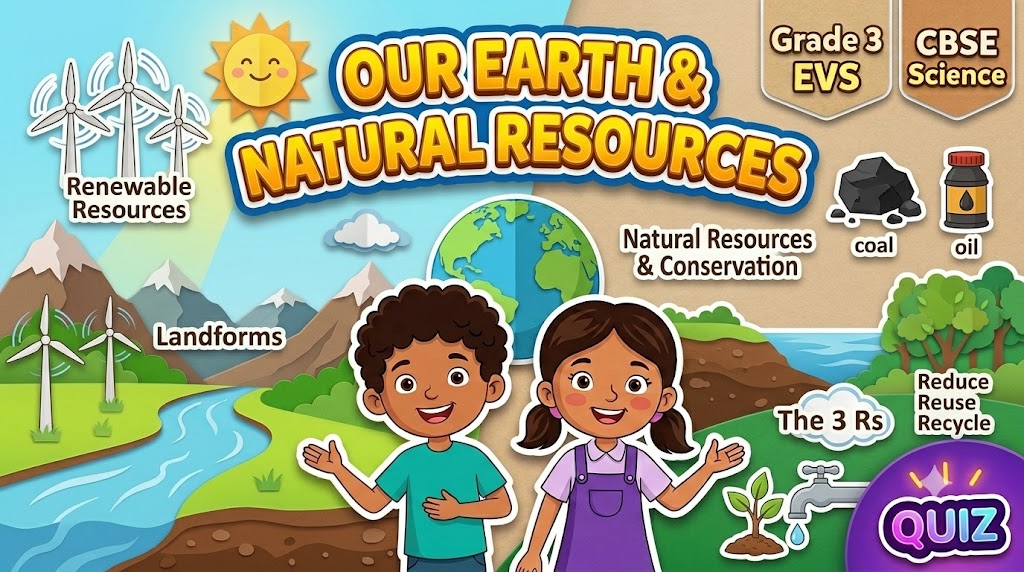
Our Earth & Natural Resources – Grade 3 EVS

CBSE Grade III Environmental sciences
4 views
Through this video, students will develop an understanding of Earth as the planet that supports life and learn about its major natural features and resources. They will explore the distribution of land and water on Earth's surface and identify different landforms, including mountains, hills, plains, plateaus and valleys, based on their shapes and characteristics. The lesson will introduce the concept of natural resources and help students distinguish between renewable resources, such as sunlight, wind and water, and non-renewable resources, such as coal and petroleum. Students will also understand the importance of conserving these resources and learn the 3 Rs of environmental protection: Reduce, Reuse and Recycle. Through familiar everyday examples, they will recognise how simple actions such as saving water, switching off unused electrical appliances, reusing materials and reducing waste can protect the environment. By the end of the lesson, students should be able to identify common landforms, classify natural resources and demonstrate awareness of responsible resource conservation.

Frequently Asked Questions

Earth is called the Blue Planet because most of its surface is covered with water, making it appear blue when seen from space.

Landforms are the natural shapes and features of the Earth's surface. Five common types are: - Mountains – High landforms with steep slopes and peaks. - Hills – Raised areas of land that are usually lower than mountains. - Plains – Large areas of flat or gently rolling land. - Plateaus – High areas of land with flat tops. - Valleys – Low areas of land between hills or mountains.

Renewable resources can be naturally replaced over time, such as sunlight, wind and water. Non-renewable resources are limited and take millions of years to form, such as coal, petroleum and natural gas.

The 3 Rs stand for: - Reduce – Use fewer resources and avoid unnecessary waste. - Reuse – Use things again instead of throwing them away. - Recycle – Process used materials to make new products.

We can save water by closing taps properly, conserve electricity by switching off lights and fans when not needed, plant trees, avoid wasting paper and follow the 3 Rs.

Practice MCQs

Question 1 of 5

Resource Info

Our Earth & Natural Resources – Grade 3 EVS

This lesson introduces students to Earth, its important features and the natural resources that support life. Students will learn about landforms such as mountains, hills, plains, plateaus and valleys, and understand the difference between renewable and non-renewable resources. The lesson also introduces the 3 Rs – Reduce, Reuse and Recycle – and encourages children to conserve water, electricity and other natural resources through responsible everyday habits.

Matched Teachers

Learn this topic with expert teachers

Based on this resource curriculum, grade and subject, these teachers can help students with concept clarity, doubt solving, practice questions and exam preparation.
Aanya Sharma Best Match Online Classes

Aanya Sharma

B.El.Ed Graduate, CTET Qualified | Skilled in Child Development, Activity-Based Learning & Teaching (Grades 1–5)
4.8 | 2+ Years
A passionate and dedicated graduate with a Bachelor of Elementary Education (B.El.Ed), a four-year integrated degre...
CBSE Grade III Environmental sciences
Find the
right teacher
for you
👩‍💼

Still confused about choosing a teacher?

Talk to our academic counsellor. We will help you choose the right teacher based on curriculum, grade, subject and learning goal.

Need personal guidance for this topic?

Learn with expert teachers from TheTuitionE. Get one-to-one support, concept clarity, homework help and exam-focused preparation.

Book Free Demo