Services Available in UAE, KSA, Qatar, India and Bahrain.
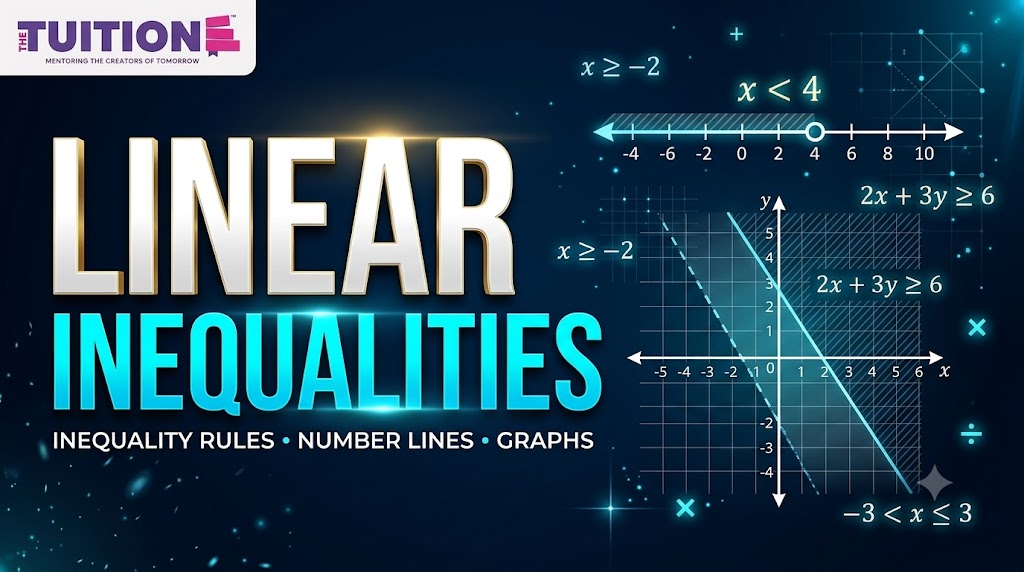
Linear Inequalities | Mathematics | Concepts, Rules and Graphs Subject: Mathematics | Grade: XI

CBSE Grade XI Mathematics
6 views
This lesson develops students' understanding of linear inequalities and their role in representing mathematical relationships involving ranges of values. Students explore the four inequality symbols and learn the rules for solving inequalities through addition, subtraction, multiplication and division, with particular attention to reversing the inequality sign when multiplying or dividing by a negative number. The lesson covers solution sets, interval notation, number-line representations and compound inequalities. Students also learn to graph linear inequalities in two variables using boundary lines, solid or dashed line conventions and the test-point method to identify the correct half-plane. Systems of inequalities are introduced through the concept of common solution regions. Teachers can connect these concepts with everyday situations such as spending limits, lift capacity, temperature restrictions and attendance requirements. By the end of the lesson, students should be able to solve, represent, interpret and apply linear inequalities accurately.

Frequently Asked Questions

A linear inequality is a mathematical statement that compares two expressions using inequality symbols. It generally involves variables with a power of one. The four symbols are: \(<\) Less than \(>\) Greater than \(\leq\) Less than or equal to \(\geq\) Greater than or equal to

Multiplying or dividing both sides of an inequality by a negative number reverses the order of the values. For example: 3<5 Multiplying both sides by \(-1\) gives: \[ -3>-5 \] Therefore, the inequality sign must be reversed.

We use addition, subtraction, multiplication and division to isolate the variable, following the rules of inequalities. For example: \[ 2x+3<11 \] \[ 2x<8 \] \[ x<4 \] The solution includes all real numbers less than 4.

An open circle represents a value that is not included in the solution, as in \(x<4\). A filled circle represents a value that is included, as in \(x\leq4\).

It is the region that satisfies all the given inequalities simultaneously. Graphically, it is the overlapping area of their individual solution regions.

Practice MCQs

Question 1 of 5

Resource Info

Linear Inequalities | Mathematics | Concepts, Rules and Graphs Subject: Mathematics | Grade: XI

Linear inequalities express relationships between quantities using symbols such as less than, greater than, less than or equal to, and greater than or equal to. This lesson explains how to solve linear inequalities in one and two variables, represent solution sets on number lines and graph half-planes. Students will also learn the rules for manipulating inequalities, including sign reversal when multiplying or dividing by a negative number, and explore practical applications involving budgets, c

Matched Teachers

Learn this topic with expert teachers

Based on this resource curriculum, grade and subject, these teachers can help students with concept clarity, doubt solving, practice questions and exam preparation.

Kavitha M Best Match Online Classes

Kavitha M

Experienced Computer Science and Mathematics faculty with 15+ years experience
4.8 | 15+ Years
A passionate and experienced Maths and Computer Science faculty member currently serving at The Oxford College of S...
CBSE Grade XI Mathematics
Rituparna Chakrabarty Experienced Online Classes

Rituparna Chakrabarty

M.Sc. Math | SAT Tutor l 9+ yrs teaching CBSE, IGCSE, GCSE , American , British , IB (AI HL/SL) , US, UK, AUS, Canadian Curricula | SAT, AP, NAPLAN + SELECTIVE EXPERT
4.8 | 9+ Years
Hello! I’m Rituparna Chakrabarty, a postgraduate in Mathematics with over 9 years of experience teaching math both...
CBSE Grade XI Mathematics
Find the
right teacher
for you
👩‍💼

Still confused about choosing a teacher?

Talk to our academic counsellor. We will help you choose the right teacher based on curriculum, grade, subject and learning goal.

Need personal guidance for this topic?

Learn with expert teachers from TheTuitionE. Get one-to-one support, concept clarity, homework help and exam-focused preparation.

Book Free Demo