Services Available in UAE, KSA, Qatar, India and Bahrain.
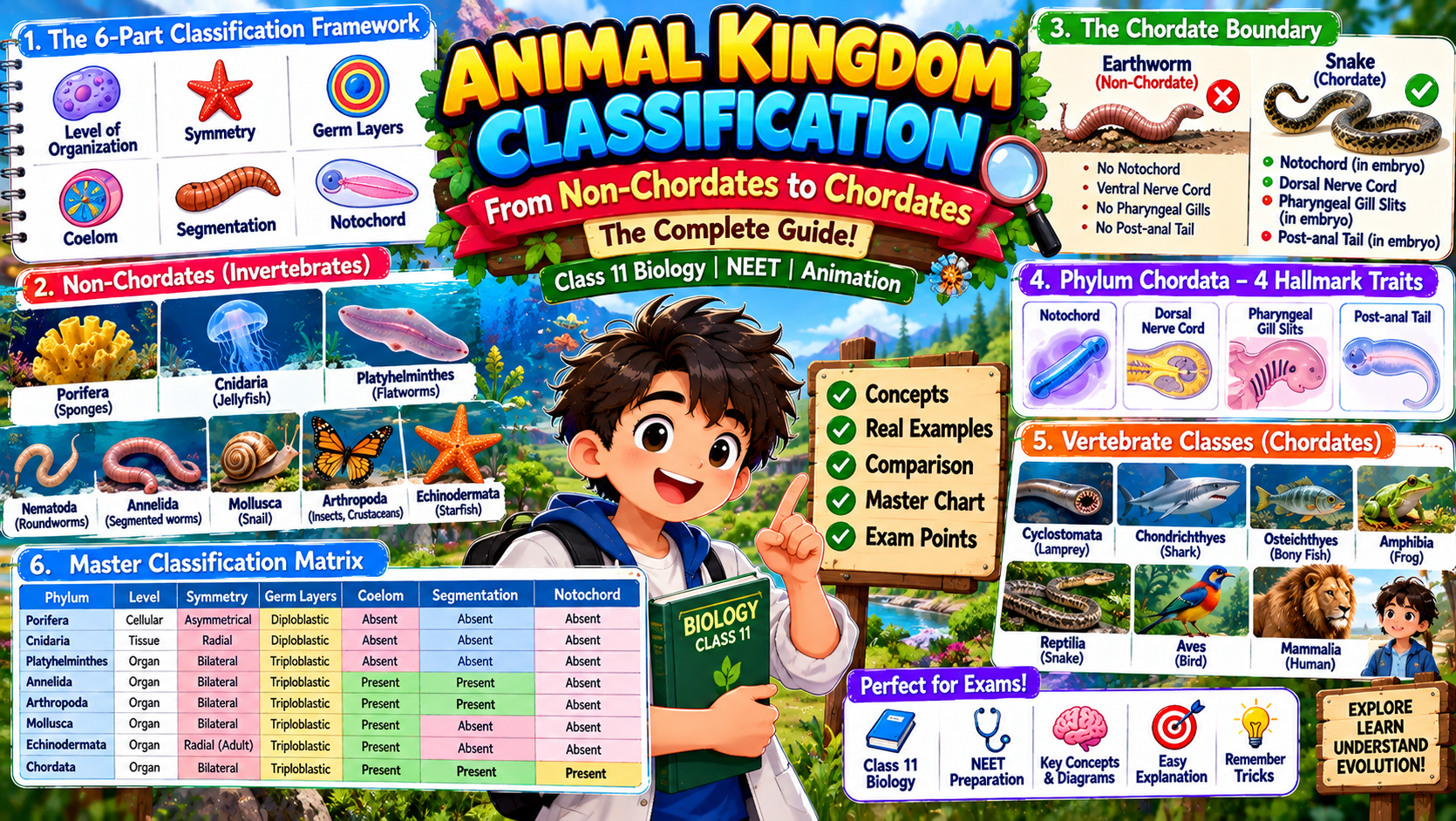
Animal Kingdom – Classification of Non-Chordates and Chordates I Class: 11

CBSE Grade XI Biology
5 views
This lesson introduces students to the systematic classification of the Animal Kingdom and explains how scientists organise animals into different groups based on their structural and biological characteristics. Students will understand the six major criteria of classification: level of organisation, body symmetry, germ layers, coelom, segmentation and notochord. The lesson explores the progression of non-chordate groups, from simple organisms such as sponges to more complex groups such as annelids and echinoderms. It further explains the distinguishing characteristics of chordates, including the notochord, dorsal hollow nerve cord, pharyngeal gill slits and post-anal tail. Students will also become familiar with the seven major vertebrate classes: Cyclostomata, Chondrichthyes, Osteichthyes, Amphibia, Reptilia, Aves and Mammalia. Through examples such as earthworms and snakes, students will develop comparative observation, classification and analytical skills. By the end of the lesson, students should be able to identify key characteristics, distinguish between major animal groups and apply classification principles to biological examples.

Frequently Asked Questions

Animals are classified based on six important criteria: level of organisation, body symmetry, germ layers, coelom, segmentation and the presence or absence of a notochord.

Diploblastic animals have two embryonic germ layers, while triploblastic animals have three germ layers. These layers are important in determining the body organisation of animals.

A coelom is a body cavity. Its presence, absence or type helps scientists classify animals into different groups based on their internal body organisation.

Chordates are identified by four characteristic features: a notochord, a dorsal hollow nerve cord, pharyngeal gill slits and a post-anal tail. These features are present at least during some stage of their life cycle.

The seven major vertebrate classes discussed in the lesson are Cyclostomata, Chondrichthyes, Osteichthyes, Amphibia, Reptilia, Aves and Mammalia.

Practice MCQs

Question 1 of 5

Resource Info

Animal Kingdom – Classification of Non-Chordates and Chordates I Class: 11

This lesson explains how animals are classified into different groups based on their body structure and biological characteristics. Students will explore the six major criteria of animal classification, including body symmetry, levels of organisation, germ layers, coelom, segmentation and notochord. The lesson introduces major non-chordate phyla, the defining characteristics of chordates and the seven major vertebrate classes, helping students understand the systematic classification of the Anim

Matched Teachers

Learn this topic with expert teachers

Based on this resource curriculum, grade and subject, these teachers can help students with concept clarity, doubt solving, practice questions and exam preparation.

Bithi Debnath Best Match Online Classes

Bithi Debnath

Experienced Biology Educator | M.Sc. Zoology | Cambridge-Trained AS and A Level Instructor | IGCSE, CBSE and PGT Expertise | Engaging, Concept-Driven Teaching
4.8 | 6+ Years
Hello! I’m Bithi Debnath, a dedicated and experienced Biology educator with an M.Sc. in Zoology, a B.Ed., and speci...
CBSE Grade XI Biology
Find the
right teacher
for you
👩‍💼

Still confused about choosing a teacher?

Talk to our academic counsellor. We will help you choose the right teacher based on curriculum, grade, subject and learning goal.

Need personal guidance for this topic?

Learn with expert teachers from TheTuitionE. Get one-to-one support, concept clarity, homework help and exam-focused preparation.

Book Free Demo