Services Available in UAE, KSA, Qatar, India and Bahrain.
Online Geography Tuitions

Geography

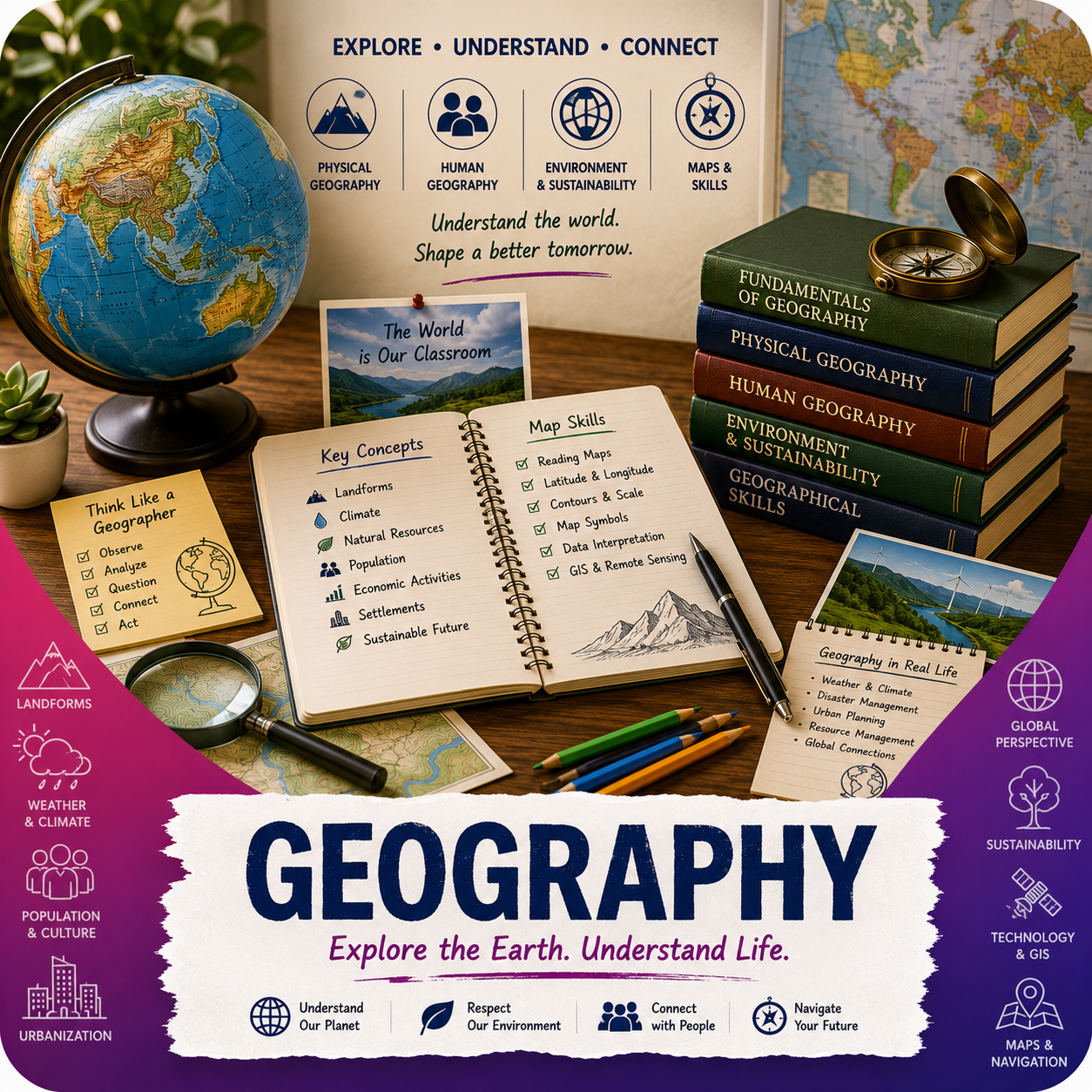
Geography is the study of the Earth's landscapes, environments, and the relationships between people and their environments. It bridges the gap between natural sciences and social sciences, offering a spatial perspective that enables students to understand the physical processes shaping our world and the human responses to those processes. Across all grades and curricula, geography helps develop a sense of place, an understanding of the interconnectivity of systems, and the skills necessary to interpret complex global issues such as climate change, urbanization, migration, and sustainability.

  • Spatial Thinking: Ability to analyze the location and distribution of features on Earth.
  • Critical Analysis: Evaluation of environmental policies, development strategies, and geographical data.
  • Research and Inquiry: Formulating questions, collecting data, and interpreting evidence.
  • Technological Skills: Using digital tools like GIS, remote sensing, and mapping software.
  • Communication: Writing reports, interpreting charts and maps, and presenting findings visually and verbally.
  • Collaboration: Working on projects related to global issues such as climate change and disaster management.

Geography education varies across grades, increasing in complexity and depth. Core components include:

  1. Physical Geography: Topics such as landforms, climate, ecosystems, rivers, oceans, and natural disasters. Younger students may learn about weather and seasons, while older students explore tectonic activity, biomes, and climate systems.
  2. Human Geography: Study of populations, migration, urbanization, economic activities, and cultural landscapes. Students analyze how human activities influence and are influenced by geographical factors.
  3. Environmental Geography: Focuses on sustainability, pollution, deforestation, conservation, and the human impact on the environment. It promotes responsible attitudes towards the Earth's resources.
  4. Geospatial Technologies: Use of maps, globes, GIS (Geographic Information Systems), and satellite imagery. Students learn to interpret data and present spatial information.
  5. Regional and World Geography: Comparative studies of continents, countries, and cities. Topics include development indicators, geopolitical boundaries, and regional conflicts.
  6. Field Work and Practical Skills: Geography often includes data collection, analysis, report writing, and map drawing. Fieldwork helps students apply theoretical knowledge to real-world scenarios.

Geography is taught to nurture informed, environmentally aware, and globally responsible citizens. It provides tools and frameworks to understand patterns and processes at various scales—from local communities to global systems. The subject cultivates critical thinking, spatial analysis, and problem-solving skills that are valuable for academic success, civic responsibility, and future careers. Geography also helps students develop empathy by examining cultural diversity and social justice issues across the world. The subject's interdisciplinary nature encourages students to synthesize information from science, history, economics, and politics.

Why Choose The TuitionE? 1:1 personalized online Geography tutoring Expert tutors across major international curricula Interactive live classes with recorded sessions Regular assessments and performance tracking Flexible class timings to fit your schedule Start learning Geography from anywhere with The TuitionE and make every lesson engaging and effective.

In primary grades, geography introduces students to basic spatial awareness, local environments, and weather patterns. They learn through interactive maps, drawings, and outdoor exploration. Middle school expands into global geography, climate zones, natural disasters, and human-environment interaction.

High school curricula like CBSE, ICSE, IB, IGCSE, British, American, and Australian systems offer in-depth study of physical and human geography, emphasizing analytical skills, fieldwork, and case studies. In programs like the IB Diploma, geography is offered as a Group 3 subject, combining internal assessments and extended research.

Across curricula:

  • CBSE & ICSE: Blend physical and human geography with map work and regional studies of India and the world.
  • British (IGCSE, A-Level): Offers a balance of theory and fieldwork; includes hazard geography, development, and sustainability.
  • IB MYP & DP: Emphasizes global contexts, inquiry-based learning, and internal assessments.
  • American Curriculum: Includes state-level geography, thematic studies, and AP Human Geography.
  • Australian Curriculum: Integrates Indigenous perspectives, Asia-Pacific studies, and sustainability.

Geography opens up diverse career opportunities in:

  • Urban planning and architecture
  • Environmental consultancy and sustainability management
  • GIS and remote sensing
  • Cartography and geoinformatics
  • Climatology and meteorology
  • Disaster management and humanitarian aid
  • International relations and policy analysis
  • Teaching and academic research

Explore the world with expert-led Geography online private classes from The TuitionE. Our one-to-one online lessons help students understand physical geography, human geography, environmental studies, map reading, and geographical concepts with ease. Our experienced tutors teach students across CBSE, ICSE, IGCSE, IB, British, and American curricula, using interactive lessons tailored to each learner's pace and academic goals. Whether your child needs support with school topics, exam preparation, or improving overall understanding, our personalized approach builds confidence and better results. With live online classes, flexible scheduling, regular assessments, and detailed progress reports, students receive the individual attention they need to excel in Geography.

Want to enroll or register for free session?

Register for Demo
Book Free Demo